



Blog
The Era of Micro-Architecture in Rhinoplasty: What Is Mosaic Rhinoplasty?

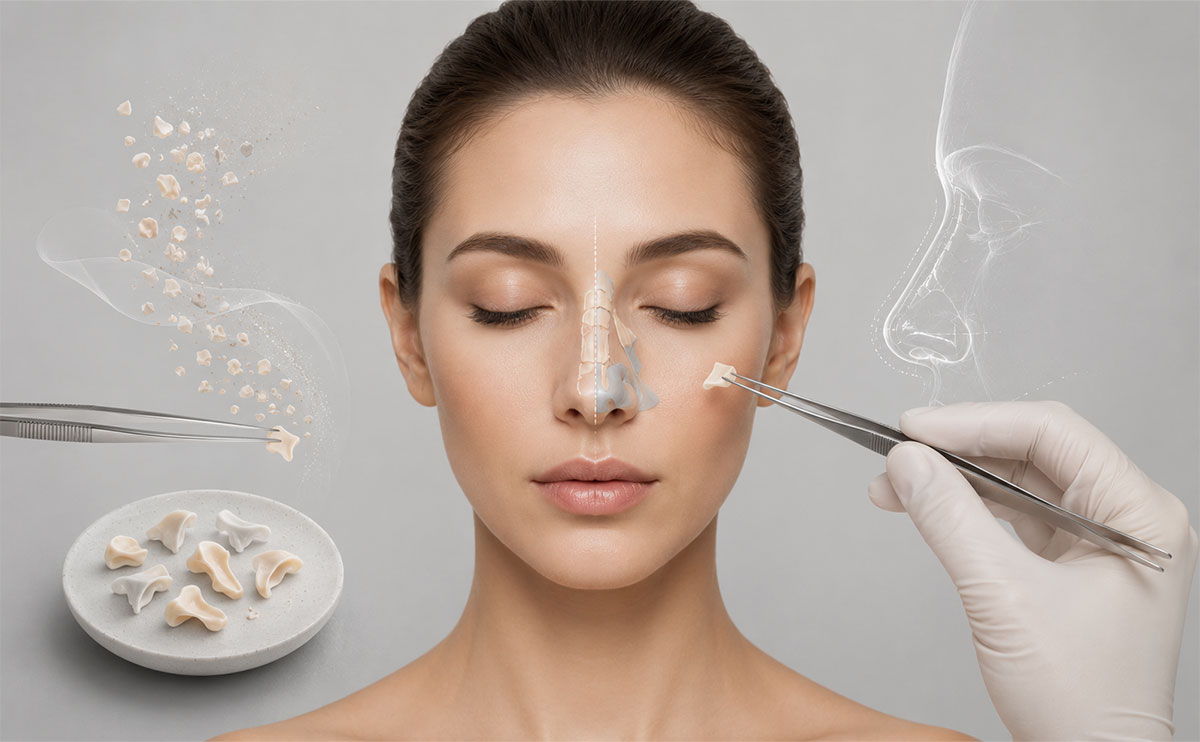
Rhinoplasty—nose reshaping surgery—is not merely about altering the shape or size of an organ located at the center of the face. Modern surgery is a multidimensional, highly skilled craft that aims to both address aesthetic concerns at the highest level and resolve functional issues, such as breathing difficulties. The Mosaic Rhinoplasty technique represents the most refined, contemporary, and artistic aspect of this process.
Conceptually, Mosaic Art and Surgical Philosophy
Throughout history, mosaic art has been defined as the process of transforming small pieces of marble, stone, glass, or terracotta—varying in color, size, and texture—into a vast composition through their precise, millimeter-perfect arrangement. Rhinoplasty is, in every sense, a surgery defined by detail, patience, and precision at the millimeter level.
The “Mosaic Rhinoplasty” technique, successfully performed by Prof. Dr. Mesut Sabri Tezer at our clinic, is executed with the meticulousness and precision of a mosaic artist. During the procedure, none of the patient’s own cartilage, bone fragments, or soft tissues—such as fat or fibrous tissue—are wasted. Instead, these valuable tissues are shaped into minute, precise components and utilized as building blocks to correct micro-level defects, depressions, and irregularities along the nasal bridge, as well as to achieve natural projection and refined detailing at the nasal tip.
How Is Mosaic Rhinoplasty Performed? Technical Details
Mosaic Rhinoplasty requires a blend of high-level surgical dexterity, aesthetic vision, and advanced knowledge of tissue engineering. To ensure that the meticulously prepared mosaic grafts fit the nasal structure perfectly, remain permanent, and provide a smooth appearance, Prof. Dr. Mesut Sabri Tezer selects fixation techniques best suited to the patient’s anatomical structure:
1. Fixation with Fine Sutures – Micro-Suture Technique
The prepared micro-fragments of cartilage and soft tissue are joined together using extremely fine, delicate, and tissue-friendly sutures—such as 6/0 PDS—that are naturally absorbed by the body. Secured to the target area with precision akin to embroidery, these tissues eventually become a natural part of the nasal bridge.
2. Seeding onto Spongostan – Mold Transfer Model
The mosaic fragments are arranged flawlessly onto Spongostan, a surgically absorbable gelatin sponge. This method enables the micro-fragments to be transferred onto the nasal dorsum as a smooth, unified layer. Consequently, there is no risk of even the slightest step-off or irregularity in the nasal profile.
3. Tisseel Tissue Sealant Technology
By using Tisseel—a high-tech fibrin sealant—the tissue segments are effectively locked into place at the target site. This method minimizes the need for sutures while significantly accelerating the biological process of tissue fusion. It virtually eliminates the risk of asymmetry or segment displacement during the postoperative period.
Why Prof. Dr. Mesut Sabri Tezer and Mosaic Rhinoplasty?
Renowned for his extensive clinical experience and academic expertise in Otorhinolaryngology (ENT) and Head and Neck Surgery, Prof. Dr. Mesut Sabri Tezer elevates rhinoplasty beyond a mere surgical procedure, transforming it into a personalized approach to anatomical management. The key advantages this technique offers our patients are as follows:
- Maximum Detail and Seamless Transitions: Even the finest contours—often difficult to refine using traditional methods—are sculpted with precision, ensuring a flawlessly smooth nasal profile.
Natural, “Non-Surgical” Feel: By utilizing the artistic harmony of micro-fragments rather than rigid cartilage blocks, the nasal bridge feels completely natural, flexible, and soft to the touch, avoiding any harsh surgical lines. - Personalized Anatomical Sculpting: Every patient has unique cartilage thickness, skin texture, and facial features. The density and placement of the mosaic fragments are meticulously planned to suit your specific facial anatomy.
- Maximum Tissue Preservation: Your own biological tissues are not discarded; instead, they are repurposed as the safest and most natural filler material to correct nasal imperfections.
Your nose, situated right at the center of your face, is key to both your health and your facial expression. If you are seeking a blend of functional comfort and aesthetic elegance, you can contact us to learn about Prof. Dr. Mesut Sabri Tezer’s vision and his “Mosaic Rhinoplasty” technique, and schedule an appointment for a detailed consultation.

